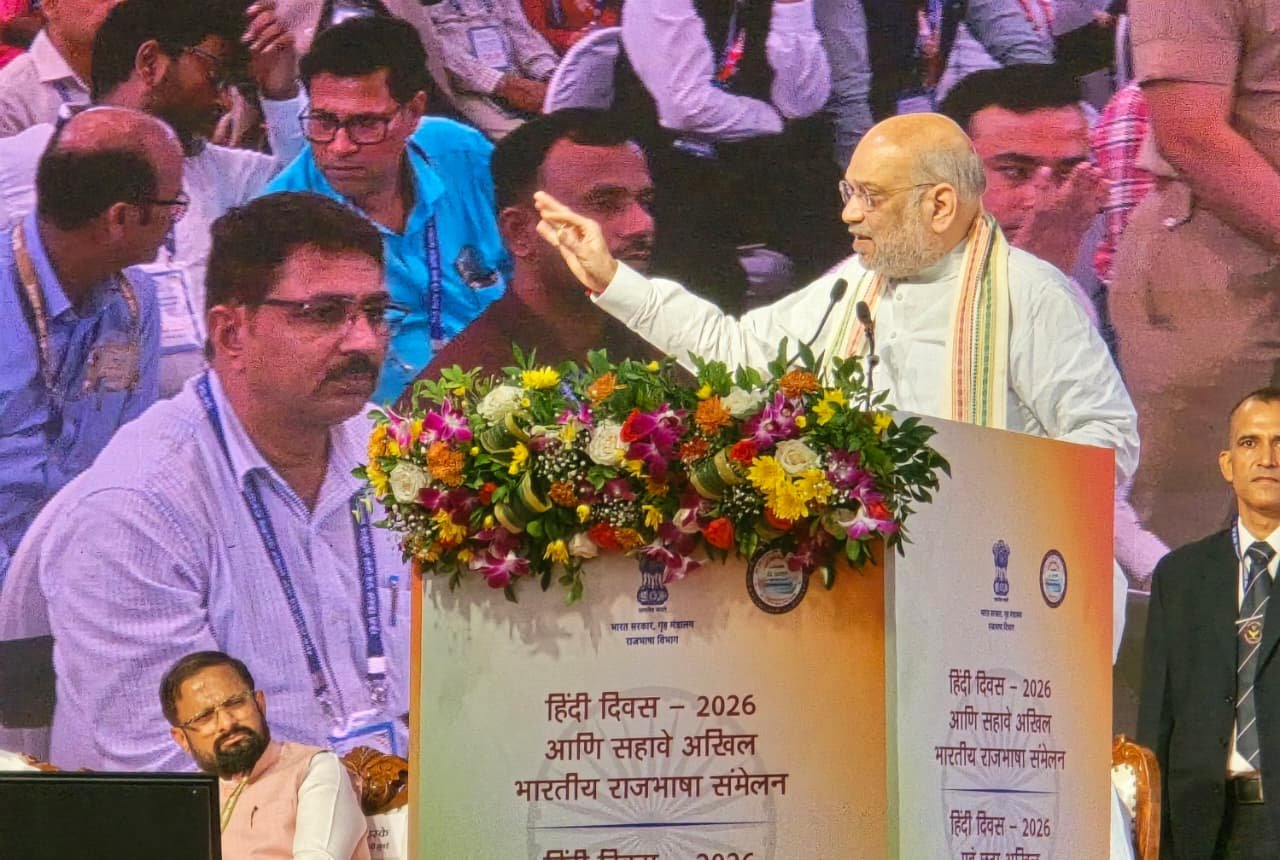

Navi Mumbai, Maharashtra: A grand Hindi Diwas Sammelan organised in Maharashtra brought together political leaders, administrators, writers, language experts and citizens from across India to celebrate the contribution of Hindi literature, promote Indian languages and discuss their expanding role in governance, education, science, technology and digital transformation.
The Sammelan highlighted the importance of Hindi as a language of communication and national integration while also recognising India’s diverse linguistic heritage and the equal importance of regional languages.
Addressing the gathering, Maharashtra Deputy Chief Minister Eknath Shinde said that Hindi has played a significant role as a connecting language among Indians and contributed greatly during the freedom movement by helping people from different regions communicate and unite for a common cause.
He said that Hindi is a companion of all Indian languages and that organising the Hindi Diwas Sammelan in Maharashtra is also a matter of pride for Marathi language and culture. Highlighting the relationship between Marathi and Hindi, he said that both languages are written in the Devanagari script and share deep cultural and literary connections.
Speaking about the contribution of Hindi literature, Shinde recalled the work of renowned writers such as Ramdhari Singh Dinkar and Dushyant Kumar, whose writings gave Hindi literature intellectual depth, social awareness and a powerful voice for public issues.
He also highlighted the contribution of Maharashtra’s great saints, including Sant Dnyaneshwar, Sant Tukaram and Sant Namdev, whose thoughts influenced Indian society beyond regional boundaries. He noted that the compositions of Sant Namdev have been included with honour in the Guru Granth Sahib, reflecting India’s shared spiritual and cultural traditions.
Hindi’s Growing Role in Administration, Science and Technology
Deputy Chief Minister Eknath Shinde said that the use of Hindi in Central Government functioning has increased significantly compared to the period before 2014. He emphasised that the role of Indian languages should not remain limited to communication but should expand rapidly in important sectors such as:
- Science and technology
- Police administration
- Law and justice system
- Governance and public services
He stressed the need for stronger use of Indian languages in modern systems so that government communication becomes more accessible and understandable for citizens.
Shinde also appreciated the contribution of Hindi-speaking citizens who have made Maharashtra their home. He said that these communities have respected Marathi language and culture while contributing significantly to the state’s overall social and economic progress.
Sunetra Ajit Pawar Emphasises Language Unity and Accessibility
Deputy Chief Minister Sunetra Ajit Pawar said that celebrating Hindi Diwas during the auspicious occasion of Ganesh Chaturthi was a meaningful coincidence.
She described Ganeshotsav as a festival that removes social barriers and promotes unity and harmony. She said that although India has numerous languages, the spirit of national unity among citizens remains one.
Highlighting the importance of Indian languages in the modern era, she said that their use must increase in:
- Administration
- Education
- Digital technology
She pointed out that Marathi and Hindi literature have enriched each other through translation and cultural exchange.
Referring to metropolitan cities like Mumbai and Navi Mumbai, she said that people from different linguistic communities living together peacefully represent the true spirit of “Ek Bharat, Shreshtha Bharat.”
She also stressed that the language of governance should be simple, clear and easily understood by ordinary citizens rather than being complicated or inaccessible.
Amit Shah Releases Publications and Launches Language Technology Initiatives
During the Sammelan, Union Home Minister and Minister of Cooperation Amit Shah released several important publications highlighting India’s literary, cultural and knowledge traditions.
The released publications included:
- ‘Rajbhasha Bharati’ – Vande Mataram Special Issue
- ‘Shiv Anadi, Shiv Anant’
- ‘Bharatiya Gyan Tantra: Srot Aur Swaroop’
- ‘Andheron Se Ujalon Tak’
- ‘Vande Mataram Ke 150 Adhyay’
The book ‘Navanvesh: Bharatiya Gyan Parampara’, published by the Defence Research and Development Organisation (DRDO), was also released during the programme.
A major highlight of the event was the launch of technology-driven language initiatives aimed at strengthening Indian language capabilities.
These included:
- ‘Bharatiya Bahubhashik Anuvad Sarathi’ — a multilingual translation mobile application developed by C-DAC.
- ‘Bhashakunj’ — an indigenous language data centre designed to strengthen digital resources for Indian languages.
Under the Pradhan Mantri Kaushal Vikas Yojana, special initiatives were also launched for citizens, including:
- Hindi dictionary resources
- Hindi typing training
- Hindi shorthand training
These initiatives underline the growing importance of language skills in employment, technology and public communication.
Rajbhasha Kirti Awards Recognise Excellence
The prestigious Rajbhasha Kirti Awards for the year 2025–26 were presented to various Central Government ministries, departments, banks and public sector organisations for their outstanding contribution towards the promotion and implementation of official language Hindi.
The awards recognised institutions that have worked towards strengthening Hindi usage in official communication and administrative processes.
Dignitaries Attend the Sammelan
The programme was attended by several prominent personalities, including:
- Maharashtra Forest Minister Ganesh Naik
- MLA Manda Mhatre
- Divisional Commissioner Rubal Agrawal
- District Collector Dr. Shrikrishna Panchal
- Navi Mumbai Municipal Commissioner Kailas Shinde
- Navi Mumbai Police Commissioner Milind Bharambe
Writers, language experts, administrative officials and citizens from different parts of the country also participated in the Sammelan.
EX7 News Analysis
The Hindi Diwas Sammelan reflects the changing role of Indian languages in the era of digital transformation and global communication.
Hindi continues to serve as an important link language, while India’s regional languages represent the country’s diverse cultural identity. The future of Indian languages will depend on their integration with technology, artificial intelligence, education, research and governance.
The challenge before institutions is not only to promote individual languages but also to create an environment where every Indian language receives respect, opportunity and technological support.
From literature to artificial intelligence, from governance to education, Indian languages are entering a new phase of growth. Events like the Hindi Diwas Sammelan highlight the importance of preserving linguistic heritage while preparing languages for the future.
Language connects communities, literature preserves civilisation, and technology can take India’s knowledge tradition to the world.
— EX7 News Bureau