Breaking News
LOOTING THE LAND
Tukaram Munde: The Commissioner Who Gave Maharashtra Hope That Change Is Possible A New Era of Public Trust, Food Safety, and Administrative Accountability
When Nature Strikes Nepal, India Feels the Impact: Understanding the Cycle of Floods, Earthquakes, and Regional Vulnerability
FROM WORLD CUP HERO TO PRISONER: Imran Khan, Pakistan’s Military Establishment, and the Battle for Democracy
Bangladeshi Hindus: Strangers in Their Own Homeland? A Humanitarian Crisis That Demands Global Attention
Thursday, Aug 27, 2026
  • Home
  • About
  • Investigations
  • Advertise With Us
  • Careers
  • Contact Us
  • National
  • Politics
  • World
  • Business & Economy
  • Crime & Investigation
  • Health & Education
  • Sports & Entertainment
  • Shows & Videos
  • Opinions & Editorials
  • Gallery
Font ResizerAa
EX7 News BroadcastEX7 News Broadcast
  • National
  • Politics
  • World
  • Business & Economy
  • Crime & Investigation
  • Health & Education
  • Sports & Entertainment
  • Shows & Videos
  • Opinions & Editorials
  • Gallery
Search
  • Home
  • About
  • Categories
    • National
    • Politics
    • World
    • Business & Economy
    • Crime & Investigation
    • Sports & Entertainment
    • Health & Education
    • Shows & Videos
    • Opinions & Editorials
    • Gallery
  • Careers
  • Advertise With Us
  • Contact Us
Follow US
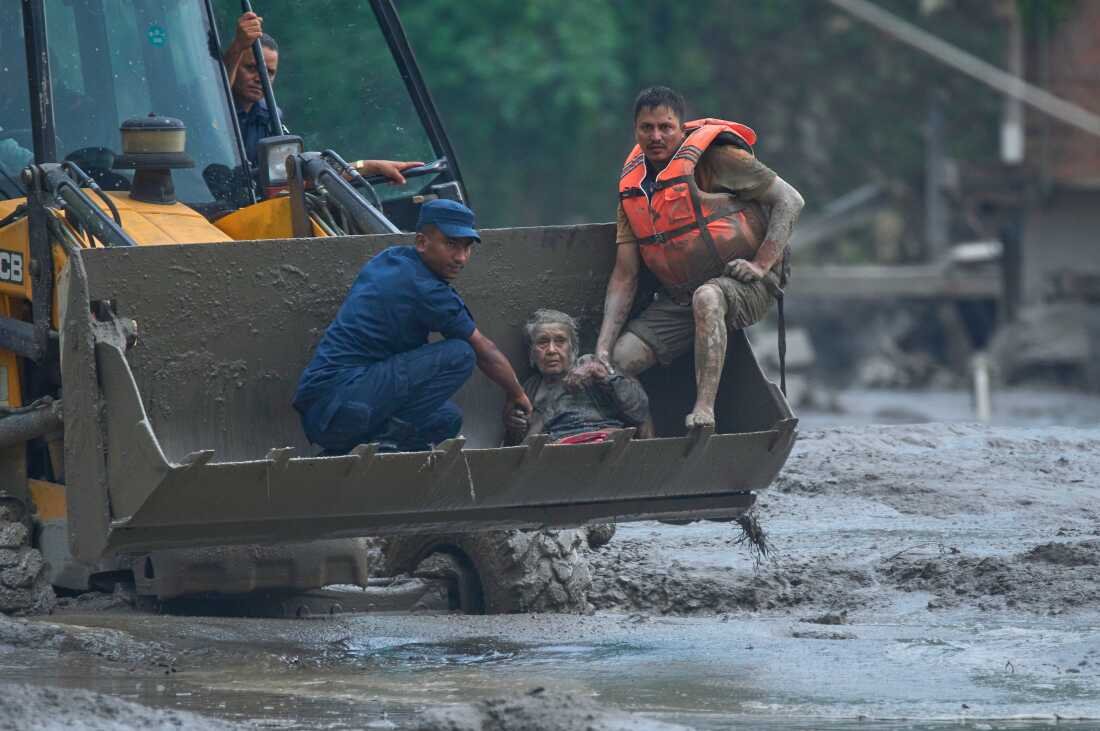
Rescuers use an earthmover to carry a victim of flash flooding to safety along the Trishuli River in Nepal's Nuwakot district, Wednesday, Aug. 26, 2026. (AP Photo/Niranjan Shrestha)
World

When Nature Strikes Nepal, India Feels the Impact: Understanding the Cycle of Floods, Earthquakes, and Regional Vulnerability

Brahmanand R. Tiwari
Last updated: August 27, 2026 2:07 am
Brahmanand R. Tiwari
Share
SHARE

Mumbai/Kathmandu: Nepal has once again been devastated by severe floods, leaving behind a trail of destruction, displacement, and human suffering. As a trusted neighbour and long-standing friend, India has once again stepped forward by extending humanitarian assistance, rescue support, relief materials, and technical cooperation. Yet, a larger question continues to confront policymakers, scientists, and disaster management experts: Why does Nepal repeatedly suffer from catastrophic natural disasters such as earthquakes, floods, landslides, and glacial lake outburst floods?

The answer lies not in a single cause but in a combination of geography, climate, geology, and environmental challenges.

Nepal is situated in the young Himalayan mountain range, one of the world’s most geologically active regions. The Indian tectonic plate continues to push against the Eurasian plate, making Nepal highly vulnerable to powerful earthquakes. The same steep Himalayan terrain also creates conditions where intense monsoon rainfall rapidly flows downhill, triggering flash floods and landslides.

Climate change has further intensified this vulnerability. Rising temperatures are accelerating the melting of Himalayan glaciers, increasing the risk of Glacial Lake Outburst Floods (GLOFs). When these glacial lakes burst, enormous volumes of water rush downstream within hours, destroying villages, roads, bridges, and hydroelectric infrastructure.

The consequences are not limited to Nepal alone.

Several major rivers, including the Kosi, Gandak, Karnali, and Mahakali, originate in Nepal before entering India’s Terai belt. During heavy rainfall or sudden glacial floods, enormous quantities of water flow into Indian states, affecting Bihar, Uttar Pradesh, Uttarakhand, and parts of West Bengal. Every year, thousands of families living in India’s floodplains face displacement, crop losses, damaged infrastructure, and economic hardship because of upstream flooding.

This makes disaster management a shared regional responsibility rather than a purely national issue.

India and Nepal have steadily strengthened cooperation in flood forecasting, hydrological data sharing, infrastructure development, and disaster response. Indian agencies frequently provide technical support, emergency relief, medical assistance, and engineering expertise during major disasters in Nepal. Such cooperation reflects the deep historical, cultural, and humanitarian ties between the two neighbouring nations.

However, experts argue that long-term solutions require stronger collaboration in watershed management, afforestation, early warning systems, climate adaptation, resilient infrastructure, and scientific monitoring of Himalayan glaciers. Investment in sustainable development across the Himalayan region is essential to reduce the frequency and severity of future disasters.

As Nepal struggles to recover once again, the tragedy serves as a reminder that the Himalayas are not merely a geographical boundary but a shared ecological system. What happens in the mountains inevitably affects the plains below.

For India and Nepal, the challenge is not simply responding to disasters after they occur but building a future where scientific cooperation, environmental conservation, and regional preparedness can save thousands of lives.

(The views expressed are based on geographical, environmental, and disaster management perspectives intended for public awareness.)

Share This Article
Facebook Whatsapp Whatsapp LinkedIn Telegram Copy Link

Popular Posts

FROM WORLD CUP HERO TO PRISONER: Imran Khan, Pakistan’s Military Establishment, and the Battle for Democracy

Brahmanand R. Tiwari
August 27, 2026

Maharashtra’s Local Body Polls 2025: Can Fadnavis & Shinde Script a New Chapter?

Brahmanand R. Tiwari
November 13, 2025

RTI Raises Questions Over ₹619.55-Crore Chinchbhuvan–MIHAN Flyover Project; Seeks Full Tender, Quality and Payment Records

Brahmanand R. Tiwari
August 10, 2026

Digital arrest’ is not real; immediately contact 1930 if you are a victim of cyber fraud.

Brahmanand R. Tiwari
August 27, 2026

You Might Also Like

World

India–Japan ‘Shark Tank’ Proposal: Can Startup Diplomacy Become the Next Engine of Strategic Partnership?

4 Min Read
World

Narendra Modi’s Global Standing: How Influential Is India’s Prime Minister Among World Leaders Today?

5 Min Read
World

Asim Munir’s Powers Expanded, Two Supreme Court Judges Resign in Protest — A Major Blow to Pakistan’s Democratic Institutions

5 Min Read
World

PM Modi’s Global Challenges at the G-20 Summit: A Strategic Analysis

4 Min Read

EX7 News — India’s trusted digital newsroom for fearless journalism. Stay informed with the latest headlines, breaking stories, exclusive investigations, and real-time updates from across India and the world — all in one place.

Twitter Youtube Linkedin
  • Quick Links :
  • Home
  • About Us
  • Careers
  • Privacy Poilcy
  • Advertise with Us
  • Contact Us

© 2025 EX7 News Broadcast Pvt. Ltd.
All content, trademarks, and materials are the property of EX7 News and its affiliates. Reproduction in any form without prior consent is not permitted. Developed by Brainfox Infotech

Welcome Back!

Sign in to your account

Username or Email Address
Password

Lost your password?