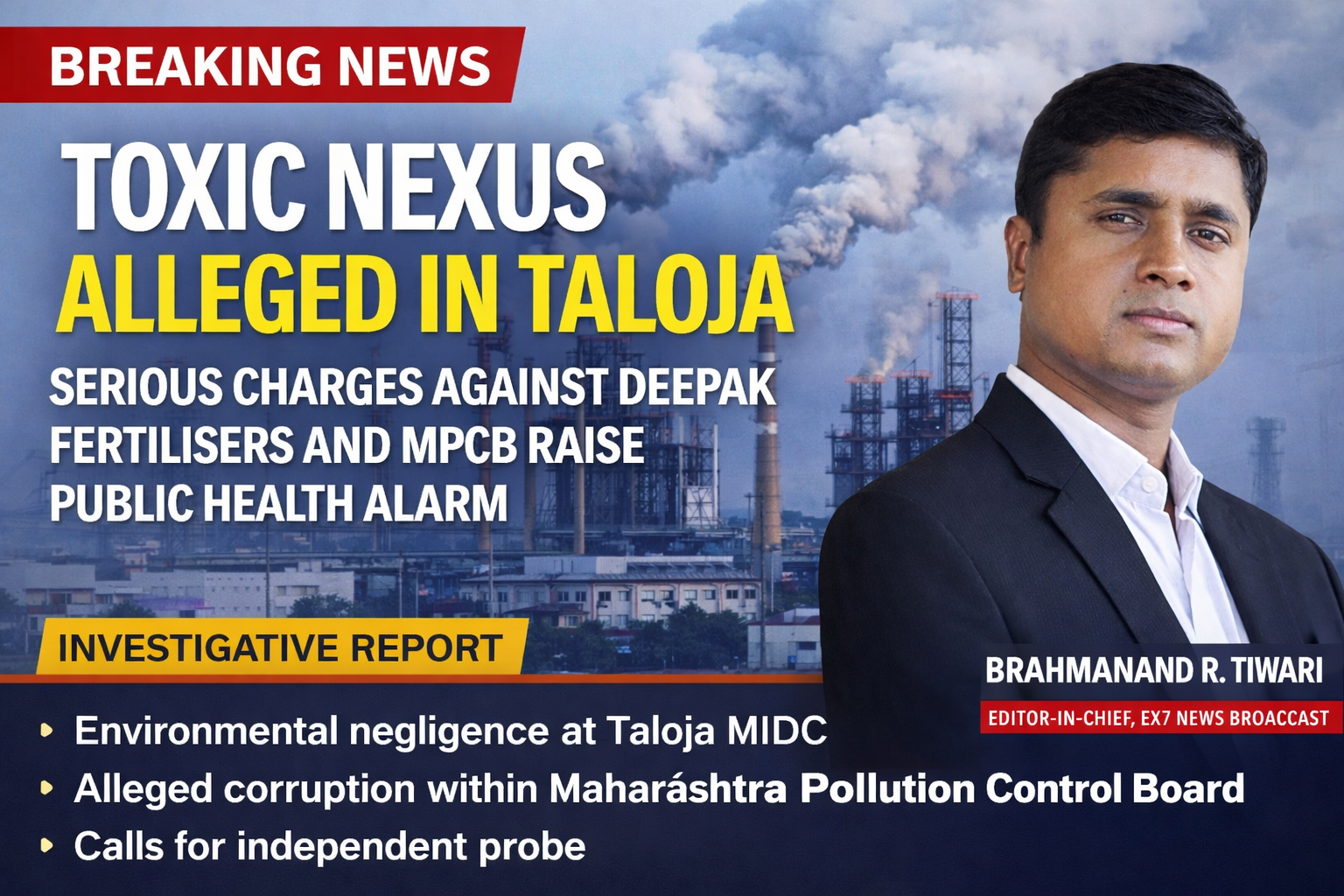

A major environmental controversy is unfolding in the industrial belt of Taloja MIDC, Navi Mumbai, where serious allegations have emerged against chemical manufacturing giant Deepak Fertilisers And Petrochemicals Corporation Limited and regulatory authority Maharashtra Pollution Control Board (MPCB) for alleged collusion, regulatory failure, and environmental negligence.
Based on extensive field investigations, documentation, and complaints submitted to the Central Pollution Control Board (CPCB), this report highlights a deeply concerning pattern of industrial pollution, administrative inaction, and alleged institutional compromise.
A Region Under Toxic Stress
Residents of Taloja, Kharghar, Roadpali, and surrounding areas have reported persistent chemical odours, respiratory illnesses, and rising cases of chronic diseases, including bronchitis and suspected carcinogenic exposure. Environmental monitoring concerns indicate excessive emissions of nitrogen oxides, volatile organic compounds, and hazardous industrial gases.
The Taloja MIDC industrial zone—housing several “red category” industries—has increasingly become a pollution hotspot, with local communities alleging that emissions peak during late-night hours to evade detection.
Corporate Accountability Under Question
Deepak Fertilisers And Petrochemicals Corporation Limited, a major producer of nitric acid, methanol, ammonia, and industrial chemicals, operates multiple units in Taloja. These facilities fall under the highly polluting “red category”, requiring strict environmental compliance under Indian law.
Despite prior notices from the Maharashtra Pollution Control Board, the company is accused of:
Violating emission and effluent standards, Dumping untreated chemical waste into drainage systems, Operating Continuous Ambient Air Quality Monitoring Stations (CAAQMS) with questionable reliability, Failing to adhere to environmental clearance conditions
Investigative findings also allege high Chemical Oxygen Demand (COD) levels, indicating severe water pollution risks.
Alleged Nexus with Regulators
Perhaps the most serious allegations involve a suspected nexus between industry operators and regulatory officials.
According to the complaint submitted to the Central Pollution Control Board, officials of the Maharashtra Pollution Control Board are accused of:
Ignoring repeated citizen complaints
Conducting superficial or pre-informed inspections, Suppressing adverse findings, Allegedly accepting illegal gratification to dilute enforcement
A joint inspection committee constituted under directions of the National Green Tribunal has also come under scrutiny, with the complainant alleging that the report submitted was “one-sided, misleading, and devoid of scientific credibility.”
National Green Tribunal Case and Procedural Concerns The matter is currently linked to proceedings before the National Green Tribunal (NGT), where objections have been raised against the findings of a joint committee comprising officials from CPCB, MPCB, and district authorities.
Key concerns include:Exclusion of the complainant from site inspections despite being a party to the case
Allegations of fabricated environmental data and manipulated lab reports
Questions over the independence and integrity of committee members
Claims of procedural violations and lack of transparency, The complainant has further alleged that the company obtained a one-sided (ex-parte) order, raising concerns about due process and fair hearing.
Public Health Crisis in the Making
Environmental experts warn that prolonged exposure to industrial pollutants can lead to:
Respiratory disorders and lung damage
Neurological and endocrine disruption
Increased cancer risk, Kidney and cardiovascular diseases, Local residents claim that air quality remains unsafe for prolonged hours daily, with pollutants entering residential areas due to proximity to industrial units.
Regulatory Framework vs Ground Reality
India has a robust environmental regulatory framework, including: Water (Prevention and Control of Pollution) Act, 1974, Air (Prevention and Control of Pollution) Act, 1981, Environment (Protection) Act, 1986, However, this case raises a critical question:
Are enforcement agencies failing in their mandate?
Despite legal provisions, the complaint alleges that inspections are largely reactive rather than proactive, and enforcement remains inconsistent.
Demand for Independent Probe
The complainant has sought:
Constitution of an independent high-level committee, Inclusion of senior officials from MoEF&CC and independent experts
Access to environmental clearance documents, consent orders, and inspection reports, Permission for independent investigation, sampling, and documentation.
There is also a demand for:
Assessment of environmental damage
Compensation for affected residents
Criminal liability for violators, if proven
Silence of Authorities Raises Questions
Despite repeated communications from the Central Pollution Control Board to state authorities, responses from concerned departments remain pending, raising concerns over administrative delay and accountability.
A Test Case for Environmental Governance, The unfolding situation in Taloja MIDC is more than a local pollution issue—it is a test of India’s environmental governance system.
If the allegations are substantiated, it would indicate:
Regulatory capture
Institutional failure
Systemic risks to public health
As the case progresses before the National Green Tribunal, all eyes are now on whether authorities will act decisively—or allow another environmental crisis to deepen.