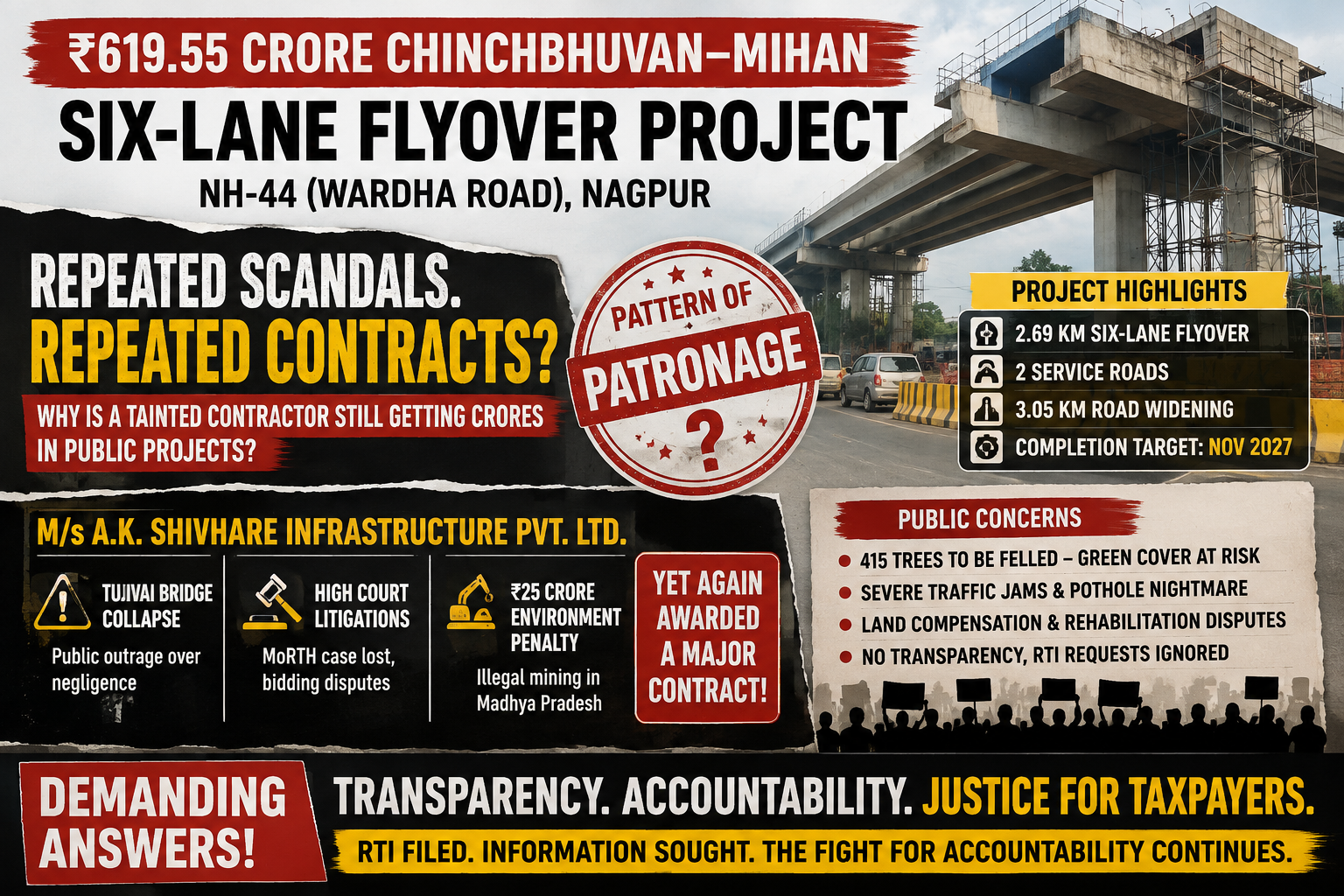

Nagpur: Fresh transparency questions have been raised regarding the ongoing ₹619.55-crore Chinchbhuvan–MIHAN Interchange Six-Lane Flyover Project on National Highway-44 (Wardha Road), one of the largest road infrastructure projects currently being executed by the National Highways Wing of the Maharashtra Public Works Department (PWD).
An extensive application under the Right to Information Act, 2005 has been submitted to the Public Information Officer, Office of the Superintending Engineer, National Highways Public Works Circle, Nagpur, seeking certified records relating to the project’s tender process, contractor selection, technical evaluation, quality control, inspections, payments and statutory compliance.
The RTI application does not allege any proven wrongdoing. Instead, it requests official records to verify whether all statutory and contractual procedures were followed during the award and execution of the project.
Key Questions Raised
The application seeks documentary evidence on several important public-interest issues, including:
– Whether the successful contractor’s litigation history, performance history and regulatory record were examined before awarding the contract.
– Whether the contractor satisfied every technical and financial eligibility criterion prescribed in the tender.
– Whether previous court proceedings, penalties or adverse performance reports were considered during bid evaluation, wherever required by the tender conditions.
– Whether bid evaluation complied with the General Financial Rules (GFR), Central Vigilance Commission (CVC) guidelines and Ministry of Road Transport and Highways procurement procedures.
– Whether any conflict of interest declarations were obtained and examined.
– Whether departmental engineers properly supervised quality, measurements, inspections and payments.
– Whether mandatory laboratory testing, third-party quality inspections and quality audits were conducted.
– Whether payments have been released strictly according to contractual milestones.
– If information relating to the project has previously been denied under the RTI Act, what lawful reasons were recorded for such denial.
Records Sought
The RTI application seeks certified copies of:
– Tender documents, bid evaluation reports and contract agreements.
– Technical and financial evaluation records.
– Due diligence and eligibility verification documents.
– Laboratory test reports and quality-control records.
– Site inspection reports and supervision records.
– Measurement Books (MBs), Running Account Bills (RA Bills) and payment records.
– Environmental permissions and statutory approvals.
– Variation orders, revised estimates and extension-of-time approvals.
– Complaints, vigilance communications and departmental correspondence.
– File notings relating to earlier RTI applications concerning the project.
Public Accountability
According to the applicant, infrastructure projects involving substantial public expenditure must remain fully transparent. Seeking official records through the RTI Act enables independent verification of whether procurement procedures, contractual conditions and quality-control mechanisms have been followed in accordance with law.
The application also requests that, where any information is denied, the department issue a reasoned speaking order citing the relevant exemption under the RTI Act and disclose all remaining non-exempt information after applying the principle of severability.
Why This Matters
The Chinchbhuvan–MIHAN Flyover Project is expected to improve traffic flow on the busy Nagpur–Hyderabad corridor by constructing a six-lane elevated corridor, upgrading the existing road network and improving junctions and associated infrastructure.
Given the project’s significant public investment and strategic importance, transparency regarding procurement, execution, quality assurance and financial management remains an important aspect of public accountability.
The RTI application seeks official records that may help clarify whether all applicable legal, technical and administrative procedures have been complied with during the execution of the project. The information supplied by the Public Works Department will determine whether any further questions arise or whether the records confirm full compliance with applicable rules and contractual requirements.