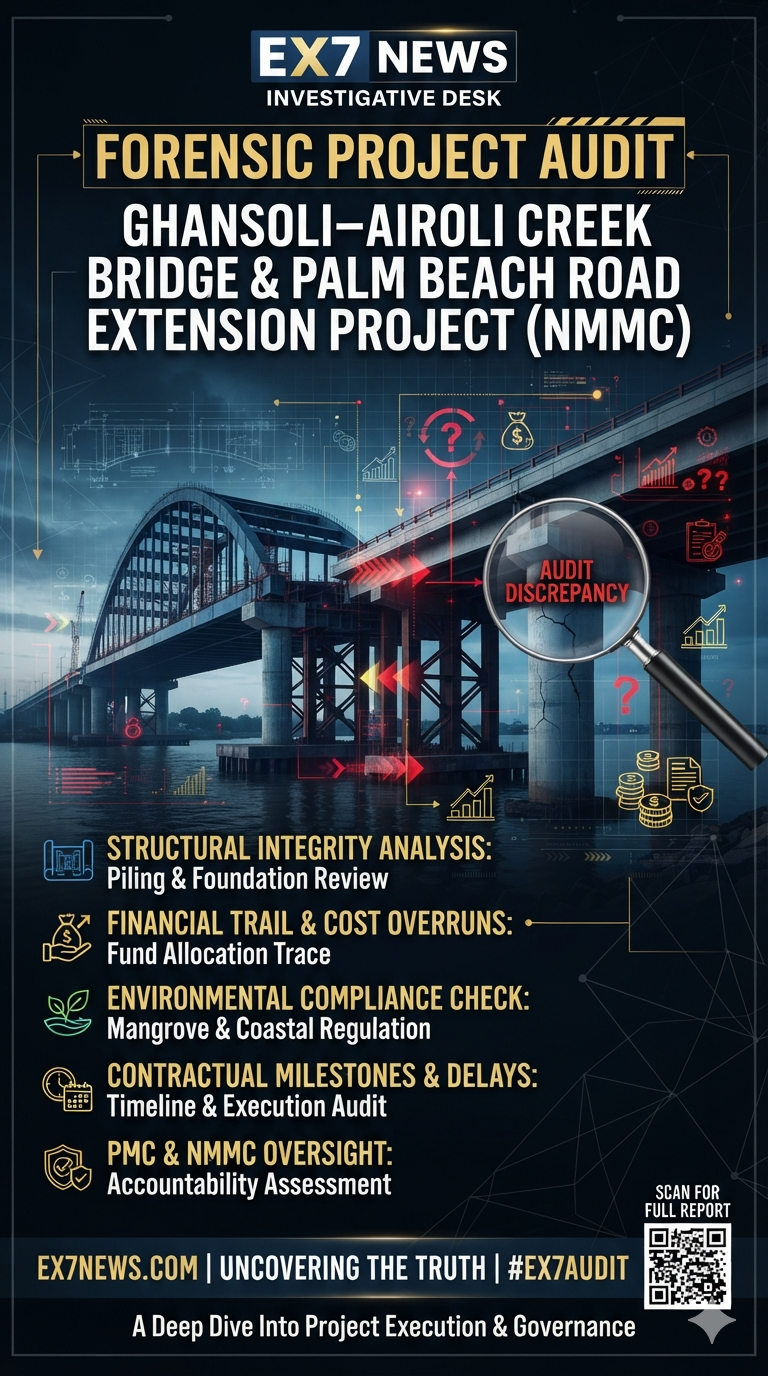

The Ghansoli–Airoli Creek Bridge and Palm Beach Road Extension has been projected as one of Navi Mumbai’s most ambitious transport infrastructure projects. Designed to reduce congestion on the Thane–Belapur Road and improve connectivity between Ghansoli and Airoli, the project carries an EPC contract value of approximately ₹493 crore and has received forest, CRZ, and judicial approvals before entering full-scale execution.
Yet, behind the promises of faster connectivity lies a series of questions that deserve careful public scrutiny.
The project involves construction through environmentally sensitive mangrove areas and required diversion of forest land, multiple statutory permissions, and compliance with stringent environmental conditions. Such projects demand not only engineering excellence but also complete transparency in procurement, environmental compliance, financial management, and public accountability.
EX7 News believes that every rupee spent from the public exchequer must withstand public scrutiny.
Among the questions that deserve answers are:
– Was the Detailed Project Report (DPR) independently reviewed before approval?
– Were all technical alternatives evaluated to minimise ecological impact?
– Has every condition imposed under forest and CRZ clearances been complied with?
– Are compensatory afforestation and biodiversity conservation measures progressing as mandated?
– Has the project remained within the approved financial framework, or have revisions increased the overall cost?
– Were all bidders evaluated transparently before award of the EPC contract?
– Have quality-control laboratories independently certified piling, concrete, and structural works?
– Are milestone-based payments being released strictly against verified physical progress?
– Have any change orders or variations altered the original project scope?
– Are marine construction activities being monitored to prevent adverse impacts on mangroves and creek ecology?
Construction is reportedly progressing with foundation works, piling operations, and substructure activities at multiple locations. However, the public deserves access to authenticated progress reports rather than relying solely on promotional updates.
Transparency becomes even more important where large public expenditure intersects with ecologically sensitive landscapes.
The role of consultants, contractors, supervising engineers, independent quality auditors, and statutory authorities must remain open to public examination. Infrastructure development and environmental protection are not mutually exclusive; both must advance together under the rule of law.
As part of its continuing public-interest investigation, The Media Foundation and EX7 News will seek official records through the Right to Information Act, including the Detailed Project Report, bid evaluation documents, EPC agreement, environmental compliance reports, forest clearance conditions, inspection reports, quality audit records, payment certificates, variation orders, and monthly progress reports.
This investigation is not an allegation of wrongdoing against any individual, contractor, consultant, or public authority. It is an exercise in accountable journalism intended to verify whether statutory procedures, contractual obligations, financial discipline, and environmental safeguards are being implemented in accordance with law.
Public infrastructure must be built with public trust.
“Investigative Journalism in the Public Interest.”