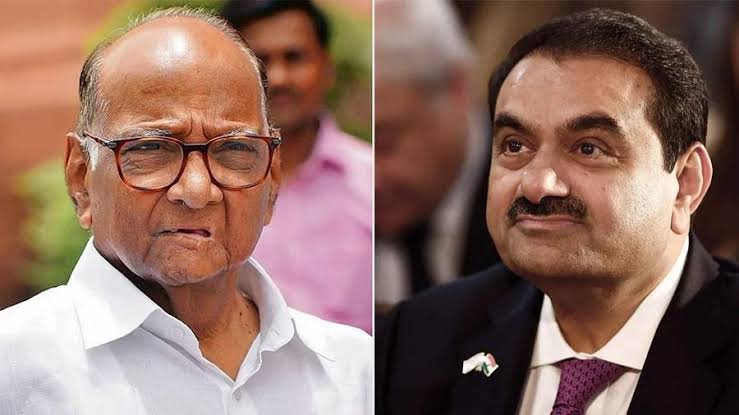

The Reunion That Sparked Political Whispers
Industrialist Gautam Adani’s recent meeting with NCP (Sharad Pawar faction) chief Sharad Pawar has once again triggered intense political buzz in Maharashtra and Delhi. While the meeting may seem like a courtesy interaction, its timing and optics carry deeper significance — especially with shifting equations inside the INDIA bloc and rising political competition ahead of the 2025 local body elections.
A Friendship Rooted in Mutual Respect and Realpolitik
Sharad Pawar — widely regarded as the Chanakya of Indian politics — has always balanced political alliances with strong relationships in the business world. From Ratan Tata to Gautam Adani, his rapport with industry leaders reflects his firm belief that economic development and political engagement must work together, not against each other.
Pawar’s association with Adani is more than symbolic. He has publicly defended Adani several times, famously noting that “industrial growth should not be politicised.” This position often puts him at odds with Congress leader Rahul Gandhi, who continues to centre his anti-Modi narrative around alleged corporate favouritism toward the Adani Group.
Rahul’s Attacks vs Pawar’s Pragmatism
While Rahul Gandhi frequently targets the Adani Group over issues ranging from monopolisation to crony capitalism, Pawar adopts a markedly different approach. His stance suggests a nuanced understanding — that private-sector giants must be engaged pragmatically, not attacked reflexively.
Insiders say Pawar views Adani as a representation of India’s industrial strength and prefers dialogue over confrontation. This aligns with Pawar’s decades-long philosophy: diplomacy over dogma, cooperation over confrontation.
Maharashtra’s Political Chessboard: What Lies Beneath?
The Adani–Pawar meeting occurs at a delicate time in Maharashtra:
-
The Shinde–Fadnavis government is consolidating its administrative grip.
-
Both NCP factions — Sharad Pawar’s and Ajit Pawar’s — are testing their ground strength.
-
Local body elections in 2025 and the Assembly elections in 2026 are approaching fast.
In this context, the meeting is widely interpreted as Pawar’s attempt to keep all communication channels open — with industry, the Centre, and key political players. It signals strategic flexibility as he navigates shifting alliances and prepares his organisation for approaching electoral battles.
Adani’s Perspective: Business Beyond Politics
For Gautam Adani, the outreach is part of his broader effort to maintain stable, cross-party relations. Maharashtra is a key state for the Adani Group, with large investments in:
-
Ports
-
Logistics
-
Energy
-
Data centres
-
Industrial and infrastructure projects
Maintaining a cordial relationship with Pawar — a veteran with influence across political lines — strengthens Adani’s long-term business continuity in the state.
A Silent Understanding, Not a Secret Pact
Both camps have downplayed political interpretations, but insiders admit there is a long-standing mutual respect between Pawar and Adani. Their understanding is founded on trust, pragmatism and a shared belief that nation-building requires partnerships, not polarisation.
As one political observer put it:
“In politics, bridges matter more than walls. Pawar’s meeting with Adani is less about alignment and more about assurance — that dialogue remains open even in ideological storms.”
A Masterclass in Political Realism
The meeting reinforces a broader truth: Indian politics is not only shaped by ideology but by relationships, communication, and strategic equilibrium. Sharad Pawar, a veteran of six decades, continues to demonstrate unmatched political realism — ensuring that he remains relevant, respected and well-connected across power centres.
As Maharashtra edges closer to crucial civic polls, the Adani–Pawar engagement reaffirms Pawar’s reputation as one of India’s last great political negotiators — a leader who understands that dialogue is the only currency that never loses value.