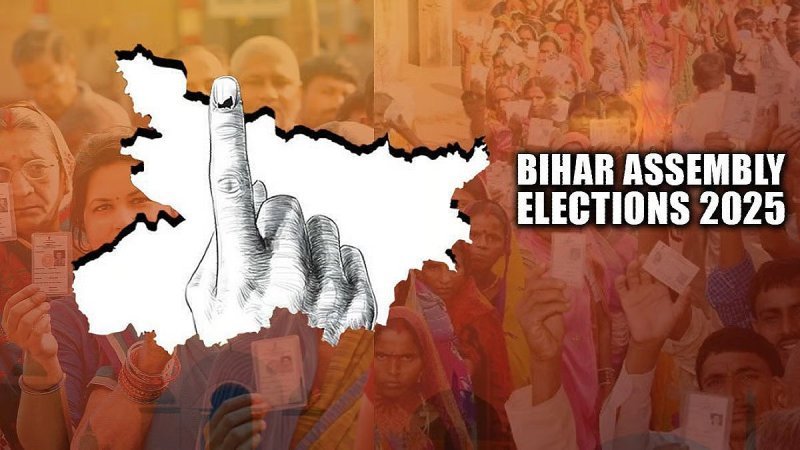

The upcoming assembly election in Bihar (243‐seat legislature) has drawn intense attention — both for its local implications and its significance for national politics. Polling was held in two phases (on 6 and 11 November 2025) and vote‐counting is scheduled for 14 November.
Key Numbers & Turning Points
Voter turnout has been historic: preliminary figures indicate around 66.9%, the highest in the state’s history.
Women’s participation stood out: female turnout reportedly higher than male turnout (e.g., ~71.6% female vs ~62.8% male in one report).
Exit‐polls (pending official results) are tilting in favour of the ruling alliance, though with caveats (see below).
Electoral Equations
Major Alliances
The ruling bloc: Janata Dal (United) (JD(U)) + Bharatiya Janata Party (BJP) under the umbrella of the National Democratic Alliance (NDA).
The main opposition: Rashtriya Janata Dal (RJD) + Indian National Congress (Congress) forming the Mahagathbandhan.
A third front attempt: Jan Suraaj Party (JSP), founded by strategist‐turned‐politician Prashant Kishor, which sought to disrupt the two‐bloc structure — but exit polls indicate very limited impact so far.
Caste, Gender & Regional Dynamics
Caste remains highly influential. For instance, exit poll data suggest the NDA received strong support among OBCs (51%) and SCs (49%) in one sample, while Muslim voters were said to favour the opposition heavily (~78%).
Gender has emerged as a critical variable: women’s turnout is high and seen as skewing slightly toward the ruling alliance in some analyses (“M Factor” – Mahila factor) because many male voters migrate out of the state for work.
Regionally: Areas with high migration, agrarian distress or poor infrastructure are key battlegrounds — both ruling and opposition blocs have focused heavily on job creation, migration relief and social welfare promises.
Major Issues Shaping the Election
Unemployment and economic distress: Many young voters cite lack of job opportunities, migration, and agricultural stagnation as reasons for change.
Electoral roll controversies and trust in process: Issues like voter‐roll purging (drop in registered electors), disenfranchisement claims have created distrust in parts of the electorate, especially among marginalized groups.
Incumbency vs change: The NDA is campaigning on development and continuity. The opposition emphasizes demand for change, pointing to governance deficits. Exit polls suggest the incumbent bloc currently has the advantage — but past wisdom cautions: in Bihar, past exit polls have mis‐predicted outcomes.
What Exit Polls Are Indicating (and What to Be Cautious About)
What They Show
Multiple exit‐polls forecast a clear lead for the NDA: seat projections for the NDA vary widely but cluster above the majority mark (~122 seats). For example, some give NDA in the ~130–160 seat range, while the Mahagathbandhan is placed significantly lower (~70–100 seats) in many forecasts.
They suggest that the JSP will likely not make substantial gains — often forecast at 0–5 seats.
Why Caution Is Needed
Historically in Bihar, exit‐polls have mis‐gauged the result: In 2020 many predicted a favourable outcome for the Mahagathbandhan but the NDA won.
The vote is very heterogeneous across constituencies; swings may not be uniform, and “wave” narratives may oversimplify local complexities (e.g., regional leaders, caste alliances, independent candidates).
High turnout, especially by women and first‐time voters, may indicate shifting patterns — but how that translates into seats is less certain than how it translates into vote share.
The counting day (14 November) remains the definitive moment — exit polls and predictions are just indicators.
My Assessment
Based on the available data and context, here are some tentative conclusions:
-
The NDA currently appears well positioned to retain power in Bihar, likely with a comfortable majority. The combination of high women’s turnout, development‐narrative, and caste coalitions appears to have worked in its favour.
-
However, the opposition Mahagathbandhan cannot be dismissed: pockets of disaffection (on jobs, migration, voter roll issues) remain, and if there is a strong regional swing in favour of change, the margin of victory for the NDA could narrow.
-
The JSP third‐front gamble seems to have limited immediate impact; its real effect might be in future electoral cycles rather than this one.
-
For national politics, a strong showing by the NDA in Bihar would bolster the party’s momentum ahead of other state polls; conversely, a surprisingly close outcome or setback would raise questions about the strength of its alliance model.
-
Ultimately, the election underscores two evolving trends in Bihar politics: the “gender vote” (high women participation) and the continuing importance — but also evolving nature — of caste and regional coalitions, now intertwined increasingly with governance and service‐delivery narratives rather than purely identity‐based mobilisation.